

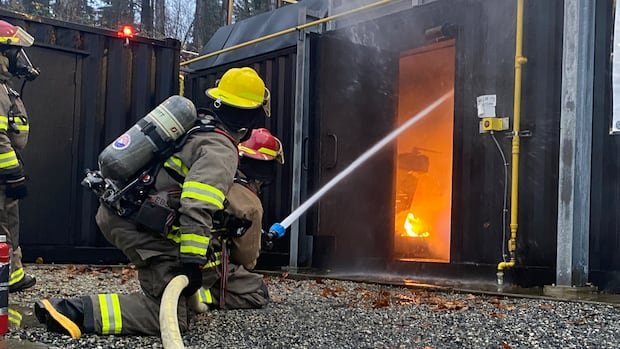

Fire crews geared up in protective gear are getting ready to put out a fire on a boat docked in Burrard Inlet. This task involves various risks, not just from the fire itself but also from navigating confined spaces within the vessel. Dwayne Higgins, in charge of rescue safety at Seaspan, highlighted the challenges crews face in reaching and extinguishing fires in such scenarios.
In a unique training initiative on the West Coast, a mock tugboat has been set up on land for crews to practice firefighting techniques. This training exercise aims to simulate a real disaster scenario on the water. The vessel, designed to resemble a small boat with stacked containers, presents challenges with its narrow passages, steep staircases, and simulated fire hazards.
At the Maplewood Fire Centre in the District of North Vancouver, municipal firefighters and Seaspan workers are undergoing intensive training to enhance their preparedness for potential boat fires in the harbor. The training emphasizes understanding vessel operations, identifying obstacles, and implementing effective firefighting strategies.
The mock tugboat, named Seaspan Responder, has been under development for four years with an $800,000 investment from the company. Recent training sessions have involved volunteer shipbuilders gaining hands-on experience in responding to fires on board. These individuals are being trained as the first line of defense in case of emergencies.
During a recent drill, trainees equipped with firefighting gear practiced containing and extinguishing a simulated fire in the ship’s kitchen. The exercise focused on teamwork, problem-solving, and ensuring safety protocols were followed. Despite some imperfections in the drill, it provided valuable learning experiences for the participants.
Local firefighters have also utilized the mock tugboat for training purposes to enhance their readiness for responding to boat fires. Gunter Kramer, assistant chief of training and professional development, emphasized the importance of additional resources and training to effectively combat fires on the bustling waterfront of Burrard Inlet.
Kramer highlighted the challenges posed by the complex jurisdictional landscape along the shoreline and stressed the need for improved coordination among various agencies and governments. The involvement of shipbuilders in firefighting training was deemed crucial due to their expertise in ship construction and the potential fire hazards associated with the industry.
In conclusion, the training exercises on the mock tugboat are essential for enhancing emergency response capabilities and ensuring the safety of both crews and vessels in the event of a marine fire incident.