

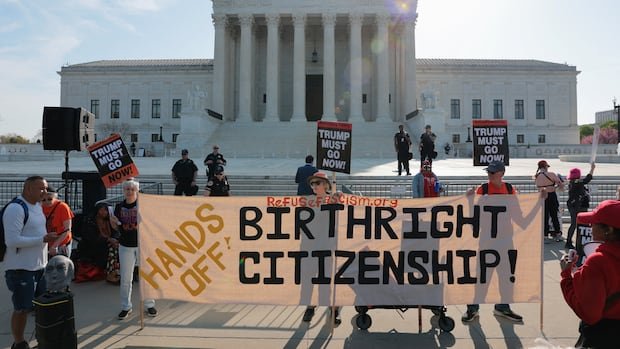

Supreme Court judges, with Donald Trump making history by attending oral arguments, addressed the legality of his executive order aimed at limiting birthright citizenship in the United States, a controversial aspect of his administration’s immigration strategy.
During the session, the judges reviewed the Trump administration’s appeal against a lower court ruling that halted the executive order instructing U.S. agencies not to acknowledge the citizenship of children born in the U.S. if neither parent is an American citizen or legal permanent resident. Both conservative and liberal judges questioned the Justice Department lawyer defending Trump’s action and posed tough inquiries to the attorney representing the plaintiffs challenging the directive.
Solicitor General John Sauer, representing the administration, argued that “unrestricted birthright citizenship goes against the practices of most modern nations.” According to research from the Global Citizenship Observatory project at the European University Institute’s Robert Schuman Centre for Advanced Studies, the U.S. and Canada are among about three-dozen nations, mainly in the Americas, that grant unconditional birthright citizenship.
Claiming that the current birthright citizenship policy encourages illegal immigration and rewards those who flout immigration laws, Sauer emphasized that Trump’s directive, issued on the first day of his second term, triggered lawsuits from affected parents and children. A lower court in New Hampshire ruled that the executive order violated the citizenship language in the U.S. Constitution’s 14th Amendment and a federal law safeguarding birthright citizenship rights.
The administration contends that unrestricted birthright citizenship has spurred illegal immigration and birth tourism, where foreigners visit the U.S. to give birth and secure citizenship for their children. Trump, dressed in a red tie and dark suit, attended the arguments, becoming the first sitting president to do so in Supreme Court history.
Chief Justice John Roberts has criticized personal attacks on judges, amid increasing threats to the judiciary. Demonstrators outside the court displayed signs opposing Trump’s actions on birthright citizenship and constitutional changes.
The 14th Amendment guarantees citizenship to all babies born in the U.S., with limited exceptions. Justice Roberts challenged arguments to restrict birthright citizenship, emphasizing that the constitution remains relevant despite changing times.
Conservative Justice Brett Kavanaugh questioned the relevance of citing foreign laws in the case. The administration argues that citizenship should be granted only to children whose primary allegiance is to the U.S., established through lawful domicile.
The ACLU argued that Trump’s order is unlawful and could have far-reaching negative impacts. Critics fear the order could lead to stricter restrictions or affect children born on U.S. soil without citizenship. The Supreme Court is expected to deliver its verdict by June, with a conservative majority potentially influencing the outcome.