

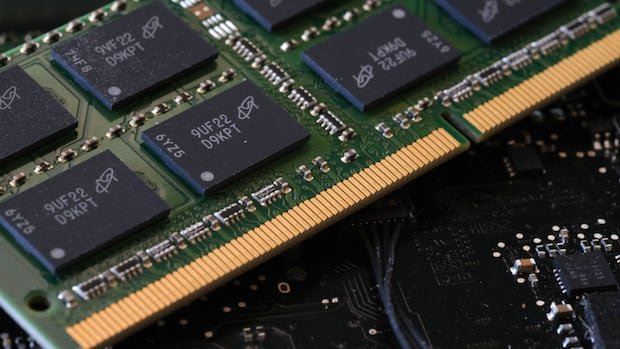

The surge in investment in artificial intelligence has resulted in a scarcity of the global memory chip supply, posing a significant challenge for consumer electronics firms worldwide. The deficiency in random access memory (RAM), a crucial component in most modern devices, is anticipated to lead to price hikes and shipping delays for items ranging from laptops and smartphones to gaming consoles and vehicles.
According to Willy Shih, a Harvard Business School management practice professor, the rapid growth in AI data center investments is absorbing a substantial portion of the market demand for memory chips. The world’s RAM supply is predominantly manufactured by three companies: South Korea’s Samsung and SK Hynix, along with the U.S.-based Micron Technology. The latter two have already sold out their high bandwidth memory chips for the remainder of the year, redirecting their production focus from traditional DRAM and flash memory to the more profitable high-bandwidth memory segment essential for AI applications.
As a consequence, consumer electronics companies are grappling with the repercussions of the memory chip shortage. Some industry giants have hinted at potential price increases and production delays once their current chip inventories are depleted. Qualcomm’s CEO Cristiano Amon attributed the company’s weak second-quarter forecast to the memory shortage, while Intel’s CEO Lip-Bu Tan cautioned that relief from the scarcity may not be imminent. Companies like HP and Dell have already started raising prices on their products in response to the crisis.
Apple’s CEO Tim Cook disclosed during a recent earnings call that the tech giant anticipates a substantial rise in memory pricing in the near future. Amidst the turmoil, smaller companies like Framework are absorbing the increased costs to maintain affordable prices for consumers. In the gaming sector, concerns are mounting that major game developers may delay releases or increase prices on new consoles to counter the impact of the memory chip shortage.
Industry analysts foresee the memory shortage persisting until the year’s end, underscoring the high stakes involved in reallocating production focus towards AI-oriented memory solutions. Should the demand for AI investment diminish, a potential memory crisis looms if manufacturers are compelled to reorient their production back to consumer-oriented memory solutions, a process that could take years to materialize.