

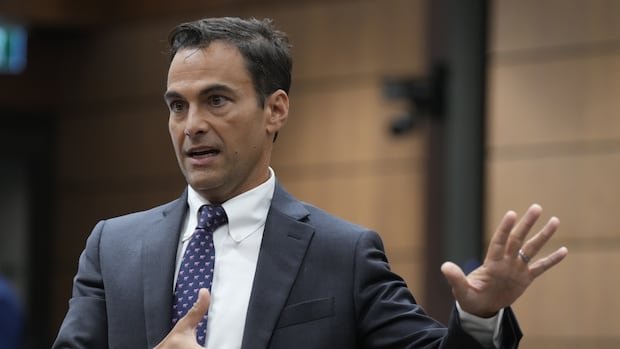

Days before Members of Parliament are scheduled to vote on the Liberal budget, interim Parliamentary Budget Officer (PBO) Jason Jacques is questioning the government’s financial management, indicating a less than 10% chance of meeting deficit targets. Despite previous comments by Jacques in September criticizing Canada’s spending as “unsustainable” and “shocking,” he now asserts that based on the PBO’s framework, the government’s finances, though tight, are deemed sustainable in the long run.
The report primarily criticizes Finance Canada for altering the reporting of deficit financing by segregating capital from operational expenditures. According to Friday’s report, the PBO finds the government’s definition of capital investments too broad. While the government plans $311 billion in capital spending from 2024-25 to 2029-30, the PBO’s analysis suggests that only $217.3 billion should be classified as capital spending. Given the subjective nature of defining capital investments, the report recommends establishing an independent expert body to determine qualifying federal spending categories and measures.
When Carney announced the separation of day-to-day and capital spending reporting, the Prime Minister highlighted the change’s intent to clarify the distinction between borrowing for government operations and borrowing for investments. The government’s broad definition of capital investments encompasses any expense contributing to public or private sector capital formation, exceeding the limits set by the System of National Accounts, an international standard governing economic activity calculations.
The budget affirms Carney’s commitment to balancing government day-to-day spending for programs and transfers within three years. However, the PBO report suggests that without the spending outlined in the 2024 fall economic statement and the 2025 budget, operational spending could have reached a surplus as early as 2026-27. The recent measures announced post-fall 2024 are projected to maintain an operating budget deficit until 2028-29, extending beyond the budget’s forecasts.
While the federal government predicts a deficit-to-GDP ratio increase to 2.5% in 2025-26 and subsequent decline to 1.5% by 2029-30, the PBO report indicates a mere 7.5% likelihood of annual ratio decline through 2029-30. This suggests uncertainties in meeting the government’s declining deficit-to-GDP fiscal anchor.
Despite the challenges, the PBO’s analysis forecasts a gradual decline in Canada’s debt as a share of GDP over the next three decades, positioning the Liberal government with a sustainable fiscal stance. Responding to the PBO’s findings, Finance Minister François-Philippe Champagne’s press secretary emphasized that the budget addresses Canada’s long-standing growth and productivity issues with a sustainable outlook balancing ambition and responsible governance.
Former Parliamentary Budget Officer Kevin Page graded the Liberal budget a B for fiscal responsibility, highlighting Canada’s sustainable fiscal structure despite a heightened debt burden. The government had appointed Jacques on an interim basis for six months but is now seeking a permanent replacement emphasizing “tact and discretion.”
In Calgary, Conservative Leader Pierre Poilievre accused Prime Minister Mark Carney of mislabeling day-to-day operating spending as investment, potentially leading to missed deficit targets and adverse impacts on Canadians. Poilievre criticized the budget as a “costly credit card budget,” foreseeing increased expenses for Canadians today and higher taxes in the future.