

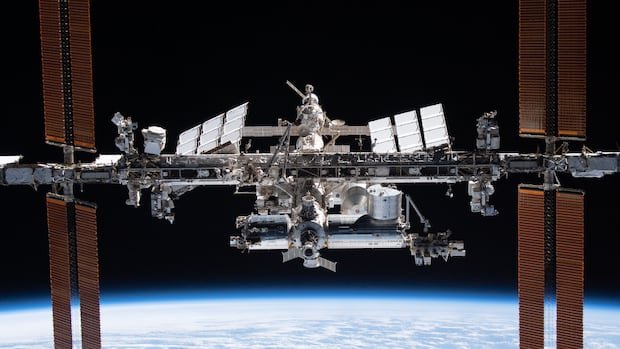

Historical structures, like Alexander Graham Bell’s residence in Nova Scotia, often transform into museums or national historic sites to safeguard their legacy for future generations. But what about preserving a colossal structure the size of a football field orbiting 400 kilometers above Earth?
NASA’s official strategy is to intentionally guide the International Space Station (ISS) into a controlled descent back to Earth’s atmosphere, where it will disintegrate in a secluded part of the ocean. However, recent developments in the U.S. government propose a reevaluation of this plan. The legislation urges NASA to explore the possibility of maintaining the ISS in low Earth orbit instead of its planned deorbiting.
Since its establishment in 2000, the ISS has hosted numerous astronauts from the U.S., Russia, Canada, Europe, and Japan. Assembled through multiple space shuttle and Russian launches, this over 400-metric-ton scientific laboratory is the largest of its kind in space, conducting various experiments in microgravity conditions.
Scheduled for decommissioning in 2030 and deorbiting in 2031, the ISS faces a fate similar to its predecessor, the Russian Space Station MIR, which plunged into the Pacific in 2001. However, some advocates, including former NASA chief of staff Rep. George Whitesides, advocate for exploring alternative preservation options before committing the ISS to destruction.
Despite the appeal for preservation, challenges arise in maintaining the ISS in orbit due to atmospheric drag causing gradual descent. Simply abandoning the station is not an option, as it would crash unpredictably within a year or two. Boosting it to a higher orbit requires substantial fuel and poses collision risks with space debris, rendering it impractical.
Engineers highlighted the necessity for constant maintenance to sustain the ISS’s functionality and safety. While private takeover propositions were unfeasible, the focus shifts towards developing new space stations like China’s Tiangong and proposed commercial space destinations.
As discussions on the ISS’s fate continue, the likelihood remains that the $100 billion space laboratory will meet its end in the upper atmosphere, with remnants sinking into the Pacific Ocean. Despite hopes for alternative solutions, the future preservation of the ISS as a heritage site remains a complex and costly endeavor.