

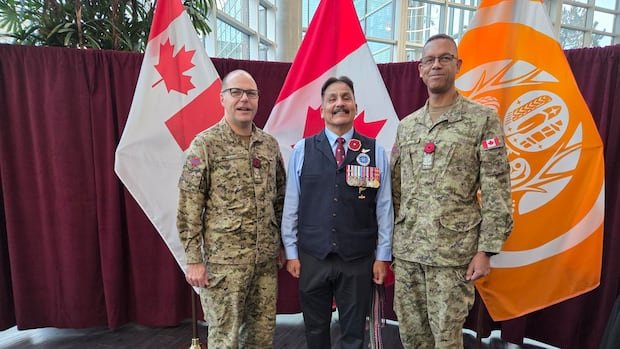

In an unprecedented move by Canada’s Armed Forces, active members are now permitted to display Indigenous-crafted poppies on their uniforms in honor of Remembrance Day. Floyd Powder, an Indigenous veteran and advocate, expressed his approval of the new policy, emphasizing that all members can wear poppies handcrafted by Indigenous artisans. These poppies, whether adorned with beads, sealskin, or porcupine quills, must adhere to specific dimensions and feature the traditional red and black colors.
During a special ceremony in Ottawa on October 31, Powder presented handcrafted poppies to Commander of the Canadian Army Lt.-Gen. Michael Wright and Canadian Army Sgt.-Maj. Chief Warrant Officer Christopher Robin. The exquisite poppies were created by Powder’s sister, Gwen Pischinger, who is a member of the Fort Smith Métis Council. Powder described the experience of presenting the poppies as a source of immense pride.
Speaking at the event, Powder highlighted the significance of Indigenous-made poppies being integrated into the uniform as a positive step towards reconciliation. Gerri Sharpe, an Indigenous artisan from Yellowknife, commended the regulation change, noting that it symbolizes a significant milestone in recognizing Indigenous perspectives within the military. Sharpe revealed that she has produced a larger number of poppies this year due to the new guidelines, emphasizing the importance of celebrating Indigenous art and heritage.
Under the updated regulations, the Canadian Armed Forces specify that the Indigenous handcrafted poppies may incorporate various materials such as beads, sealskin, porcupine quills, caribou bone, and other culturally significant elements. Sharpe expressed her satisfaction at the prospect of seeing these unique poppies on uniforms, highlighting the opportunities this initiative creates for Indigenous artisans to showcase their talents. This move is seen as a positive step towards incorporating Indigenous art into a traditionally non-Indigenous space, promoting inclusivity and cultural diversity.