

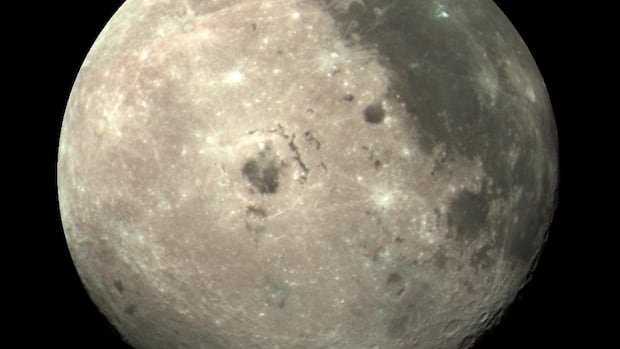

When Jeremy Hansen, the Canadian astronaut, embarks on the Artemis 2 mission beyond the moon, part of his duties will involve observing the far side of the moon, a region invisible from Earth. Simultaneously, scientists on Earth are keenly observing as they plan to deploy telescopes and robots to explore deep space from that vantage point.
The moon, being gravitationally locked to Earth, constantly presents one face towards our planet while the other side gazes out into space. Although commonly referred to as the “dark side,” this is a misnomer as it receives just as much sunlight as the Earth-facing side.
Characterized by a rugged, crater-filled terrain, the far side of the moon stands in stark contrast to the near side, which boasts expansive flat plains known as “Maria,” denoting “seas” in Latin. This region also offers a serene environment shielded from Earth’s artificial radio interference, making it an enticing location for astronomers to set up radio telescopes.
Access to the far side of the moon is exclusive to spacecraft, affording Hansen a rare opportunity to witness sights rarely seen by humans since the Apollo missions. Unlike the Apollo astronauts who orbited close to the lunar surface, Hansen will travel 7,500 kilometers beyond the moon on the Artemis mission, granting him a unique global perspective.
During the lunar flyby, the Artemis crew will engage in meticulous observations of the lunar surface through the windows, leveraging the human eye’s ability to discern subtle details that cameras might overlook. These observations, such as variations in color and shades of grey, hold crucial insights into surface conditions that could impact future spacecraft landings.
Among the missions planned for the far side is the Japanese TSUKUYOMI, or Lunar Meter Wave Telescope, which aims to place radio dishes on the lunar far side to explore the universe’s early days during the “dark ages.” By detecting faint radio signals emitted by neutral hydrogen gas post the big bang, researchers hope to unravel the mysteries surrounding dark matter’s role in shaping the early universe.
The deployment of TSUKUYOMI and other planned observatories, like LuSEE Night and Farside Seismic Suite, underscores the burgeoning interest in lunar exploration and radio astronomy. While human missions prioritize colony establishment and water ice discovery at the moon’s south pole, robotic observatories on the far side will delve into the universe’s origins, hidden from direct view but poised to unlock profound cosmic secrets.