

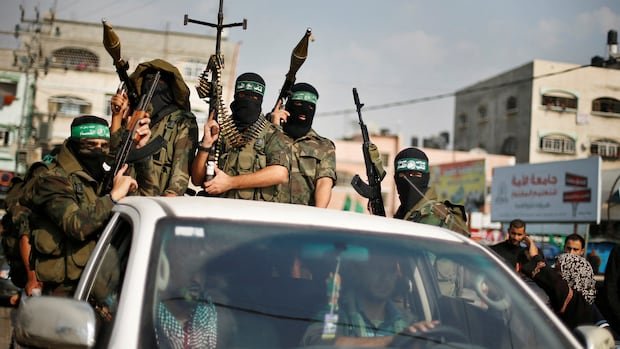

Israel has expressed significant security apprehensions to the White House regarding the proposed disarmament agreement with Hamas, as per an Israeli official on Sunday. This marks one of the initial public statements following U.S. President Donald Trump’s announcement of the deal.
Doron Spielman, the spokesperson for the Israeli Prime Minister’s office, conveyed that Israel’s intelligence evaluation indicates that Hamas is inclined towards reconstructing its military rather than genuinely demilitarizing. He emphasized that the Israeli military would not retreat from Gaza, where it governs over 60% of the region, until Hamas relinquishes its arms.
Spielman stressed the necessity for Hamas to physically surrender its weapons to meet the disarmament criteria. This stance follows Hamas’s recent commitment to commence disarming under the U.S.-brokered ceasefire agreement signed nine months ago to conclude the protracted conflict. However, numerous obstacles, prerequisites, and extended timelines lie ahead despite this potential breakthrough.
Trump’s 20-point ceasefire blueprint mandates the militant group to give up its arms, dismantle its extensive tunnel network, facilitate Israeli forces’ withdrawal from Gaza, establish a new technocratic Palestinian government, deploy an international security force, and initiate the reconstruction of the devastated Palestinian enclave.
The issue of Hamas disarmament has been a persistent challenge, impeding negotiations for months. Trump asserted that the deal, unveiled on social media, would be implemented through meticulously structured phases.
As per a verified copy of the accord obtained by the AP, all weapons held by the Hamas-controlled police will be handed over to the U.S.-backed Palestinian technocratic committee upon its arrival in Gaza. The subsequent steps, including decommissioning heavy weaponry, dismantling military production facilities and tunnels, are contingent upon the arrival of the Palestinian committee and the deployment of international forces. The decommissioning process will be synchronized with a phased Israeli withdrawal, as outlined in the agreement.
The areas under Israeli jurisdiction in Gaza have largely suffered destruction and depopulation, with the majority of Palestinians residing in squalid conditions in other parts of the territory. Israel is unlikely to make substantial concessions or withdraw significant forces prior to the October elections. Prime Minister Benjamin Netanyahu faces a challenging re-election campaign, with pressure from far-right coalition partners to maintain pressure on Hamas and retain forces in Gaza, while opponents criticize his handling of the 2023 attack.
During the 2023 conflict, Hamas-led militants assaulted Israeli communities, resulting in approximately 1,200 fatalities and 251 hostages. Subsequently, Israel launched a severe military offensive that reportedly claimed over 73,000 lives, according to the Gaza Health Ministry data.
Israel, while acknowledging Trump’s commitment to its security and resolution efforts, remains resolute in its stance on disarmament based on intelligence indicating Hamas’s ongoing military build-up. The specifics of Israel’s communication with the White House remain undisclosed, although sources revealed that concerns were relayed to former British Prime Minister Tony Blair, a member of the Trump-led Board of Peace.
Since the ceasefire’s inception last October, Israel has continued targeted strikes on Gaza, citing operations against Hamas and its infrastructure. Recent Israeli strikes resulted in the deaths of at least 17 individuals, including children, as reported by local hospitals. The Israeli military stated that these strikes aimed at Hamas military operatives.
It is crucial to note that ongoing developments in the region indicate a complex and delicate path towards sustainable peace and security in the Gaza Strip.