

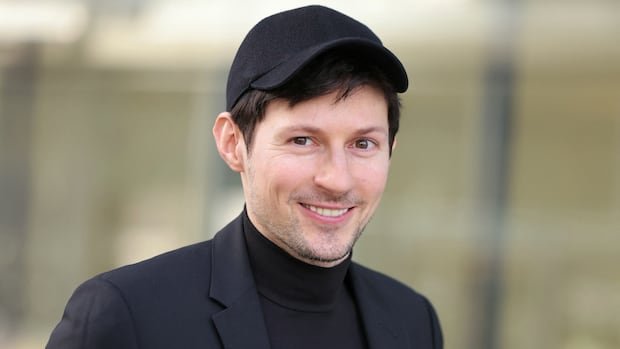

Russia’s primary internal security agency announced on Wednesday that Pavel Durov, the creator and proprietor of the messaging application Telegram, has been indicted for supporting terrorism and placed on an international wanted list. The accusations against Durov, who originated from and initially launched his career in Russia before relocating abroad, coincide with the Russian government’s ongoing restrictions on Telegram, a widely-used messaging app in the country. These measures are part of a broader initiative to tighten control over the internet by the Kremlin, a campaign that has escalated since the commencement of Moscow’s full-scale invasion of Ukraine in February 2022.
The Federal Security Service, commonly known as the FSB, alleged that Telegram’s management failed to remove various channels, chats, and bots that were being actively utilized by Ukrainian intelligence agencies, terrorist groups, and extremist organizations to plan and execute acts of sabotage, terrorism, mass violence, and cybercrime within Russia, resulting in numerous casualties. The FSB specifically accused Ukrainian security services of leveraging a popular dating chatbot on Telegram to entice and enlist Russians for illicit activities, with 46 chatbot users between the ages of 12 and 22 apprehended across Russia since July 2025 for offenses such as assaulting law enforcement personnel and arson.
Earlier this year, Durov disclosed that Russian authorities had initiated a criminal probe against him, alleging that the government was fabricating excuses to impede access to Telegram as part of a broader effort to curtail privacy rights and freedom of expression. If found guilty, Durov could potentially face a life sentence in Russia. Despite requests for commentary, Telegram, which boasts over 1 billion users globally, remained silent. The company’s official website directs users to a profile featuring an image of Durov making an obscene gesture towards the camera.
According to Telegram’s website, the company is headquartered in Dubai, and Durov, who holds citizenship in both France and the United Arab Emirates, resides there as well. Under the leadership of President Vladimir Putin, Russian authorities have pursued various strategies to regulate the internet, encompassing the enactment of restrictive legislation, the banishment of non-compliant websites, and advancements in technology to oversee and manipulate online traffic.
Numerous prominent social media platforms like Facebook, Instagram, and others have been outlawed in Russia, while YouTube has been limited, and messaging applications like Signal and Viber have been blocked, with WhatsApp and Telegram facing restrictions. Additionally, Russia’s popular social media platform VK, founded by Durov prior to Telegram’s launch, has since fallen under the control of Kremlin-affiliated entities. Although some restrictions can be circumvented through virtual private networks, these services are frequently subject to blockades as well.
Simultaneously, Russia has been actively promoting the “national” messaging app Max, which critics argue could be exploited for surveillance purposes. Developed as a comprehensive platform for messaging, online government services, payments, and more, Max openly acknowledges its willingness to share user data with authorities upon request and is noted for lacking end-to-end encryption.
Durov has encountered legal troubles in other jurisdictions. In 2024, he was arrested in Paris on charges related to illicit activities facilitated by his platform, such as drug trafficking and the dissemination of child sexual abuse content. Durov acknowledged returning to Dubai in March 2025 following a period spent in France. At the time of his arrest, the Kremlin condemned the French authorities for their actions against Durov, characterizing them as biased.
Putin, in a statement from September 2024 after Durov’s arrest, indicated that various countries had expressed concerns regarding platforms like Telegram being misused by individuals and entities posing potential threats to national security and economic stability. While acknowledging the Russian government’s possible reservations about Durov’s activities, Putin criticized the French authorities for their selective actions, suggesting that similar measures should be taken against other platforms engaging in similar practices.