

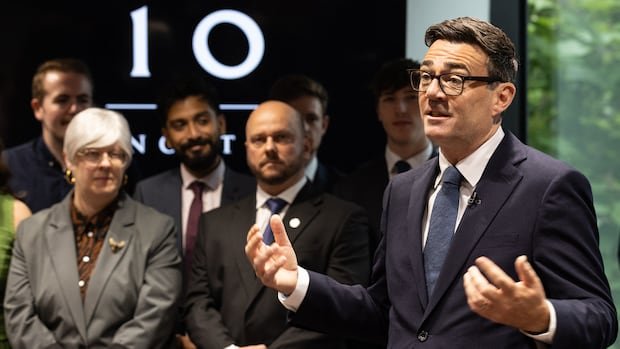

British Prime Minister Andy Burnham is set to officially inaugurate a new government establishment in Manchester known as “No. 10 North” on Friday, reminiscent of his office at 10 Downing Street in London. This move by Burnham, who took office after succeeding Keir Starmer earlier in the week, aims to decentralize economic decision-making from the capital city.
“No. 10 North” will commence operations from Heron House in central Manchester. While the current office accommodates the northern hub of Britain’s intelligence, cyber, and security agency, plans are underway for a new government campus in another part of the city, although completion is expected to take several years.
Burnham is anticipated to work from the Manchester site weekly, with other ministers also utilizing the office regularly, according to government statements. Manchester, a city with a populace of nearly 600,000 renowned for its football clubs and past “Madchester” music scene, is located approximately 300 kilometers northwest of London.
The financial implications of the relocation in terms of additional security costs remain undisclosed. Recent reports from British media outlets suggest that unspecified civil servants from Whitehall government offices in London are being offered relocation packages.
In a social media post on Friday, Burnham expressed, “Britain doesn’t need more decisions made in Whitehall. It needs more power in the hands of people and places that know their communities best. That’s exactly what No. 10 North will deliver.”
Opposition Leader Kemi Badenoch of the Conservative Party has raised doubts about Burnham’s focus on national governance, criticizing his approach as resembling that of a mayor rather than a national leader. Concerns have also been raised by political adversaries regarding the expenses associated with the move, particularly during a period of constrained public finances.
Burnham has characterized his premiership as a “circuit-breaker” from past political norms. The decision to establish an office in Manchester reflects his persistent advocacy for devolving power from Westminster to cities and regions.
On Friday, Burnham was scheduled to lead the first meeting of a reinvigorated National Economic Council, a high-level governmental body that brings together senior ministers and regional mayors to coordinate the country’s economic growth strategy. The council, originally established in London during the 2008 financial crisis by former Prime Minister Gordon Brown, is designed to synchronize the government’s response to economic challenges.
Burnham’s political background includes serving as a Member of Parliament during the Labour administrations of both Gordon Brown and Tony Blair.