

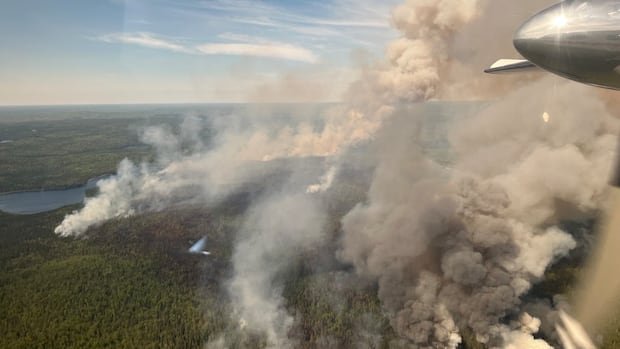

As wildfires ravage Ontario in its most severe season on record, a recent study from McGill University highlights the role of aspen trees as a natural fire barrier. Flavie Pelletier, the lead author of the research and a PhD graduate, noted that aspen have long been known for their resilience to fire, despite their thin bark that can burn rapidly.
Through an analysis of satellite imagery of Canada’s boreal forest pre and post wildfires, Pelletier and her team observed that extensive patches of aspen can hinder the spread of wildfires. The images revealed that larger clusters of aspen were predominantly present at the edges of burned areas.
Pelletier explained that aspen’s higher moisture content in both trees and leaves, as well as the positioning of their leaves higher up on the trunk compared to coniferous trees like spruce and pine, contribute to their effectiveness as a fire barrier. She highlighted the ongoing challenge faced by aspen in commercial forests, where forestry companies often target them with herbicides like glyphosate to promote the growth of coniferous trees for lumber production.
Fred Pinto, a forestry adjunct professor at the University of Toronto, acknowledged the return of broadleaf vegetation like aspen following glyphosate spraying, which typically takes five to ten years. While Pinto mentioned that only a small portion of Ontario’s boreal forest is harvested annually and disputed claims of increased wildfire vulnerability due to glyphosate spraying, he emphasized the negligible impact of glyphosate in forest smoke given the small quantity relative to total biomass.
Despite concerns about the impact of herbicides on aspen populations, Pinto noted that the current wildfires in northern Ontario are largely occurring in untouched areas that have not been subject to harvesting or glyphosate treatment. He also highlighted the minimal presence of glyphosate in wildfire smoke, stating that the intense heat of wildfires would likely eliminate any residual chemicals.
The study sheds light on the critical role of aspen trees in mitigating wildfires and raises important questions about the long-term implications of herbicide use in forest management practices.