

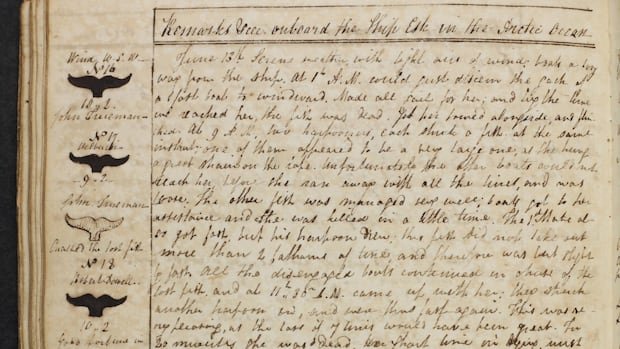

The historical impact of whaling practices can be vividly illustrated through the mundane accounts left behind by whalers.
One logbook entry from July 14, 1874, described a whale as “an eight-foot three incher” yielding approximately eight tons of blubber.
These records, along with many others, have been analyzed in a recent study published in the Proceedings of the National Academy of Sciences, shedding light on the extensive bowhead whale hunting during the 1700s and 1800s.
Nicholas Freymueller, a lead author and extinction biologist at Adelaide University in South Australia, emphasized the brevity of these entries, underscoring the gravity of the mass extermination that transpired.
Before the commercial exploitation of bowhead whales in the 18th century, their populations were estimated to be at least 50,000, dwindling to as low as 3,000 by the 1920s, as per estimates.
Remarkably, insights gleaned from these logbooks have enabled researchers to construct maps that offer insights into the survival patterns of bowhead whales in contemporary times.
Economic Significance
Matthew Ayre, a co-author of the study and a historian based in Vancouver, delved into these historical accounts for over a decade, unraveling the language of a trade that sustained economies.
Whale oil was so pervasive that, as Ayre noted, every streetlight in London was once illuminated by it, leading to the emergence of nightlife in Europe to combat the darkness.
The high demand for whale oil made bowhead whales a coveted target due to their abundant blubber, which could be processed into oil, and their valuable baleen, used in products like whalebone corsets.
According to Brenna Frasier, senior curator of zoology at the Nova Scotia Museum in Halifax, these whales played a pivotal role in various economies, driving lucrative hunting expeditions that necessitated meticulous record-keeping for both navigation and financial incentives.
Ayre highlighted that logbooks were crucial for obtaining bounties, requiring ships to present them at customs houses, thus safeguarding the preservation of these historical documents.

Elaborate Hunts
These logbooks not only documented the practicalities of whaling but also captured the emotional responses of crews during hunts, such as the excitement upon spotting a harpooned whale.
Entries, like one dated May 7, 1814, vividly described the chaos and urgency that ensued when a whale was harpooned, offering a glimpse into the daily lives of whalers and the intricacies of the hunt.
Moreover, they contained detailed accounts of the hunting process, from striking the whale to flinching the blubber, and recording crucial information like whale lengths and baleen pieces.
Nicholas Freymueller utilized these detailed records, coupled with computer modeling, to reconstruct a comprehensive narrative of whaling expeditions spanning time and geography, showcasing the evolution of whaling practices across the Arctic region.